

'Quality Control' One Week Later: Not as Simple as It Seems
You've seen the film—now here's the story behind the economic anxieties, personal inspirations, and adaptation choices that brought it to life.


Greetings!
Before we get started today, I wanted to take a moment to say hello and extend a warm welcome to everyone who’s subscribed since I published my post about David Tennant’s long-lost short film Quality Control last Saturday. It’s been incredible (and a bit overwhelming) to see so many new faces around here.
If you’re one of those newbies, first of all: thank you, and welcome aboard! Secondly, I hope you’ve noticed my past archive of posts and have had the chance to poke around a bit. Over the years I’ve written about all sorts of corners of David Tennant’s career, from obscure television appearances and little-known audio dramas to rare, early theatre productions that until recently hadn’t even shown up on his Wiki page! So if you’re the curious-about-David sort (and if you’re reading this, I suspect you probably are), there’s quite a lot in my past archives just waiting to be discovered.
Now then...
A week has passed since I shared Quality Control, and I thought it might be fun to revisit this remarkable little short film one more time. By now, hopefully most of you have had the chance to watch it.
If not, well...what are you still doing here? Off you go! You can find it by clicking below, and once you’ve done that, scurry on back:

—
Today I thought we might peek behind the curtain a bit.
I’ve already mentioned that I’ve spent over a year chatting with Hannah and Duncan via email about Quality Control’s origins and production. Hannah told me she’d chosen Duncan’s short story as the basis for a film she needed to make as part of her coursework at the University of Edinburgh. She’d chosen David as her lead actor because she’d seen him in Takin’ Over The Asylum and thought he had the right energy to play Gary Innes.
Hannah didn’t pay David for doing Quality Control. She was upfront about only being able to afford a round-trip train ticket from London to Edinburgh and a meal on set. She was shocked when he agreed to do it anyway. Looking back, Hannah thinks perhaps David was more keen to be involved once he learned her script was an adaptation of Duncan’s short story from his Somerset Maugham Award-winning collection Bucket of Tongues.


When I first wrote about Quality Control, there were quite a few things I deliberately held back. I wanted everyone to have the chance to experience the film for themselves first and think their own thoughts about it without coloring their impressions.
But now that some time’s passed, I think it’s safe to take a look at the film through the eyes of the people who brought it into being: writer-director Hannah Lewis and author Duncan McLean, whose short story inspired the adaptation in the first place.
Much of the rest of this post delves into their inspirations and frames of reference, and how all of this informed the film’s characters and situations. I think it gives Quality Control some important and much-needed context.
After the Film Was Released: What Hannah and Duncan Saw in Quality Control
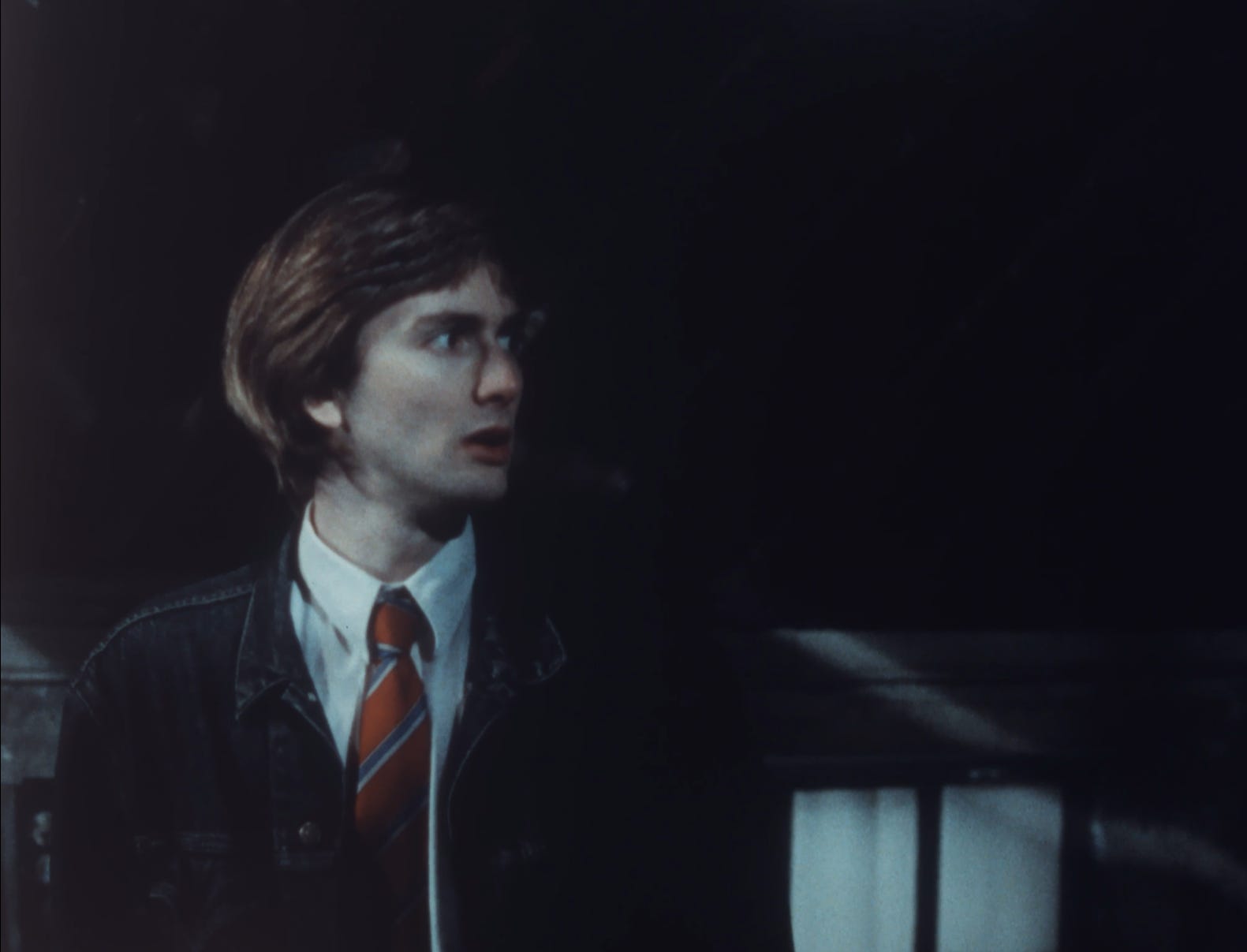
Now that we’ve all had the chance to watch Quality Control, I suspect many of you had the same initial reaction to it I did. On the surface, it feels like a fairly simple, linear story, right? It’s funny, charming, and easy to follow. A young man gets a job testing skateboards, takes the task a bit too seriously, and pays the price for it. But the more I spoke with Hannah and Duncan about the film, the more I thought that assessment might sell it rather short.
In an email exchange I had with Hannah and Duncan after I premiered the film, Hannah touched on something that made me reconsider my first impressions. “I remember back in the day some people said Quality Control was ‘simple’, or [had] ‘a simple premise’,” she wrote. “To me it was full of nuance and captured such a sign of the times, hence why I immediately fell for it.”
That idea—that the film’s doing more beneath the surface than first appears—became even clearer when Duncan shared with me and Hannah what had inspired him to write the original story in the first place.
In 1988 I was in my early 20s and working as a caretaker at the bandstand in Princes Street Gardens, Edinburgh. One of the other janitors was a guy called Matt, who was in his 40s and had had a string of dead-end jobs, whereas I had only had one or two at that point. He used to amuse me (and himself) in quiet moments by telling tall tales of past employment in the docks of Rotterdam and the black squads of Sheffield factories. One of the more improbable tales he told was of being hired as Quality Controller in a dodgy skateboard factory in London. He got sacked at the end of his first day after every single board he tested ‘failed quality control.’ He was meant to rubber stamp every board as in perfect condition, not stress test them to breaking point by doing something outrageous like standing on them.
At the time I was living in a bedsit in Pitt Street in Leith, Edinburgh. It had been an industrial area, but by the 80s most of the warehouses were empty, and factories had closed or were closing. At the end of the street was an engineering works of Dickensian squalor, where the workers had been on strike for a year, partly over pay and partly over demands to get holes in the roof fixed so it didn’t rain on them as they worked. The air was filled with fragrant aromas from the steaming dog food factory down by the weed-choked canal. Here and there were sparks of life, tiny businesses started up people inspired by desperation or the Thatcher government’s exhortations in favour of a new concept, entrepreneurism – the idea that all that was needed to build a successful business was the desire to succeed, a bit of hard work, and a willingness to ignore things like safe working conditions, fair wages, and good quality products. Dingy sweatshops were the in thing.
A couple of years later I sat down to write a story, and Matt’s skateboard tale and Leith’s blighted economic landscape came together in my head as Quality Control.
When I watched Quality Control for the first time, I had laughed at David as he enthusiastically destroyed skateboards. It was also easy for me to take it at face value, because I didn’t have any context for what I was watching. Duncan had given me that context.
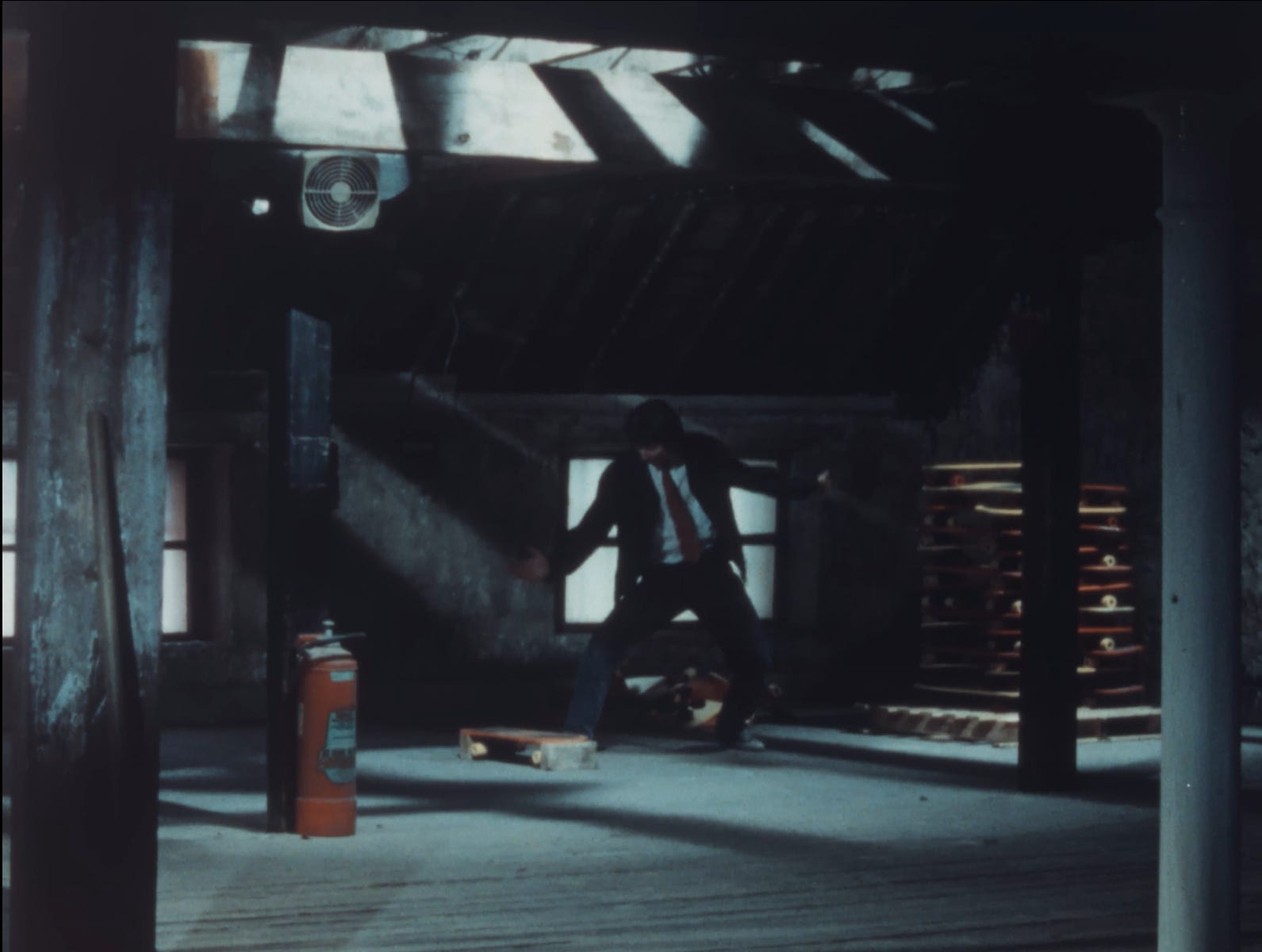
The next time I watched the film, I was able to look at it in a different light. It made sense to me why Mr. Ghopal was cutting corners and pushing his products out the door regardless of their quality, and why he (and Gary) were involved in the Manpower Services Commission (the “MSC” referred to in the film, which was one of several government schemes intended to help unemployed people find work).
You can easily watch Quality Control simply as a comedy, if you like, because it’s really quite funny. But I think it helps the enjoyment of the film as a whole when you know more about its background and influences, and that beneath the laughs, there’s quite a bit more to it. I’m glad I’m able to share a little bit about its hidden history with all of you.
Quality Control Through Duncan and Hannah’s Eyes
One of the unexpected pleasures of the year I’ve spent talking with Hannah and Duncan before the release of the short was the opportunity to continue speaking with them both about Quality Control’s origins and production. Both of them were extraordinarily generous with their memories, and were pretty patient with my constant questions.
And of course, the short’s ultimate rescue was the delicious cherry on top!
I can’t really describe the exhilaration I felt when Hannah sent me and Duncan an email back in November 2024 letting us know she had a digitized copy of the black and white version of Quality Control ready to share. “I watched it today for the first time in 20+ years and it’s not that bad, actually,” she wrote. “With good writing (Duncan) and good acting (David), I was on to a winner!”
We all watched it as soon as we got it, and then there was a flurry of emails back and forth as we all shared our reactions.


“What a treat to see this again after all these years,” Duncan wrote. “I found that I vaguely remembered the shot of DT knocking on the door at the start, but absolutely nothing else.”
A similar flurry of emails occurred when Hannah eventually telecined the film from its 16mm print and sent me and Duncan a color copy. Duncan thought the enormous warehouse was a fantastic choice of location, and Hannah mentioned she’d made one of her decisions about how the film looked in direct response to how dark and colorless the set was. “I made a point of the skateboards being quite gaudy, and the saris being colourful,” she told us.
Watching the short again after nearly three decades, Duncan found himself reflecting on aspects of the story very differently than he might have in the early 1990s:
It’s a wonderful thing to be able to watch it after all these years. Not just because of the novelty of seeing its star at such a young age, nor just because of the striking lighting and cinematography, but because – as well as those things – it’s like a time machine back to Thatcher’s Britain, and the Scotland of my youth. I really liked the setting, the filming, the lighting, and the acting; apart from David, the others didn’t have much to work with, but they did a good job.
The only aspect I didn’t like was the bit I was responsible for – the dialogue! What worked on the page (or so I thought at the time) doesn’t sound natural spoken aloud – or it doesn’t now, thirty years later. I think that’s partly to do with the very fame our central actor has achieved; we know his voice so well that to hear him speak my stumbling, Leith-working-class-accented lines sounds awkward. ‘Just be yourself, David,’ I want to say. ‘Use your own voice.’ Because now, of course, we know what his natural speaking voice is, and we know that this isn’t it. But neither you, Hannah, nor David, nor anyone else could have guessed then that we would ever be in a position to think like this. So we are left with my clumsy attempts at portraying an insecure, inarticulate, slightly desperate young lad through a few dozen words.
Duncan mentioned the now-hopelessly outdated tech, too. “It was funny to see the enormous mobile phone used by Mr. Ghopal. Cutting edge at the time, but now so old-fashioned, it’s like seeing someone driving a horse and cart!”
Duncan also talked about his inspiration for the characters of Gary and Mr. Ghopal.
“Gary Innes stands for a vast number of people at that time, young men and women from a working-class background who could not find work (because there was no work)…if you were in Gary’s position, you had to try and make a go of these jobs, even though you knew they were as flimsy as a knock-off skateboard, because if you didn’t, you would lose your benefits.”
And Mr. Ghopal?
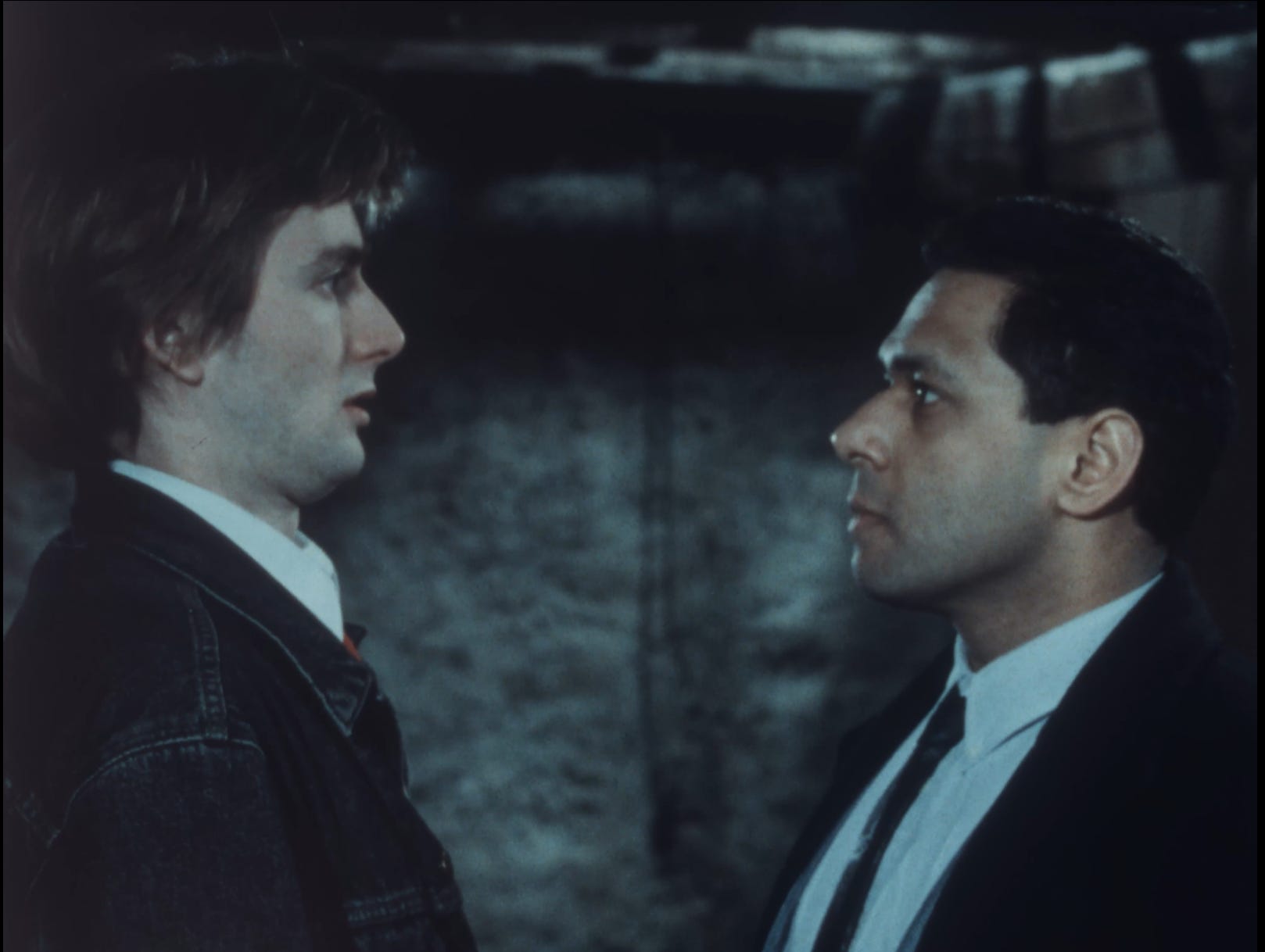
“Mr. Ghopal was, I suppose, a portrait of another creation of the Thatcherite era,” Duncan explained. “He was the chancer making and selling shoddy goods to make a quick buck, powered by nothing but self-confidence and the only mobile phone within a mile.”
But the origin of the character, it turns out, also had roots in Duncan’s own experience. “I took that, I think, from a very nice man who ran a grocer’s shop with his wife at the end of my street,” Duncan said. “I remember Mrs. Ghopal once gave my flatmate a sari. I don’t remember why; they must have taken pity on us as we scrabbled around their shop looking for the cheapest possible everything.”
The Film’s “Why”? Moments: The Women
While talking with Duncan about Gary and Mr. Ghopal, another question I’d been wondering about since my first viewing of the film resurfaced.
What’s the story behind the women?
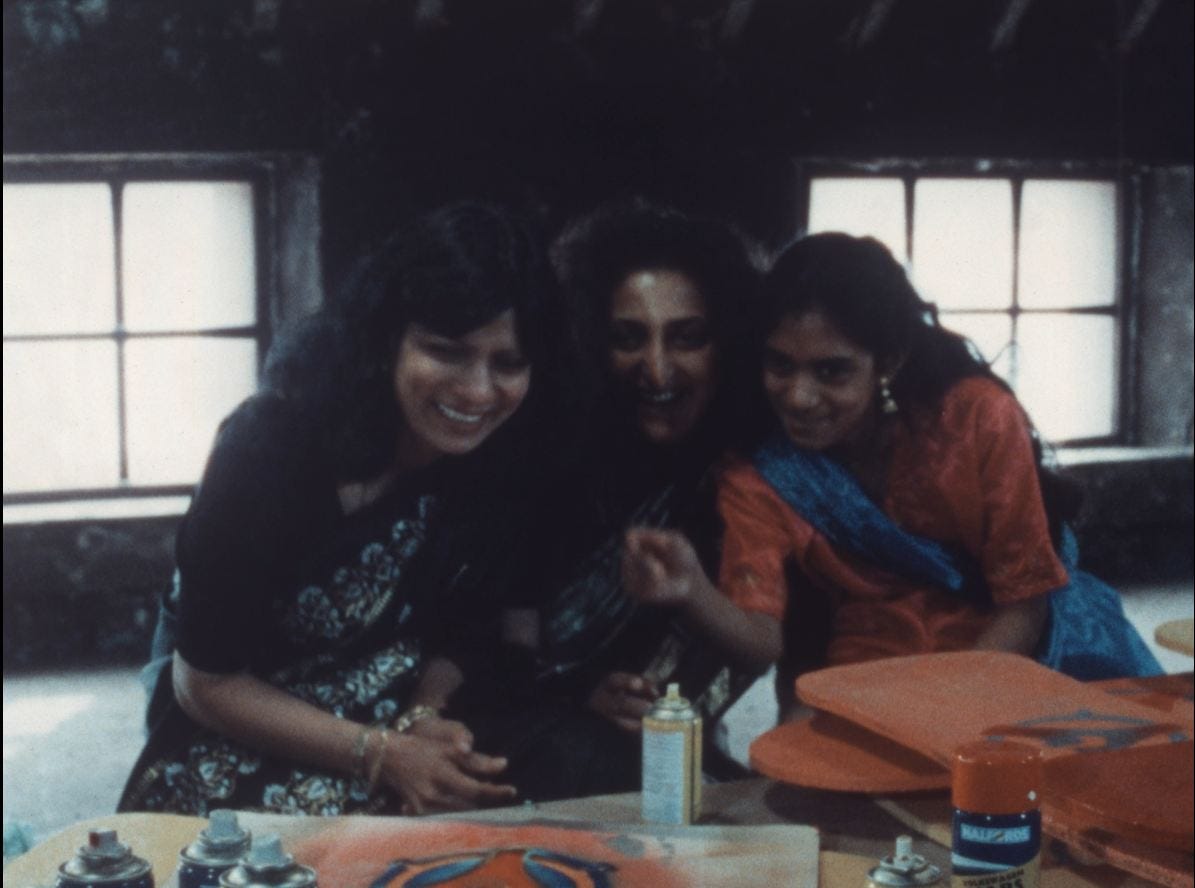
The relative silence of the women working in Mr. Ghopal's factory really stuck out to me while watching Quality Control. In Hannah’s film adaptation, they whisper among themselves at Gary’s increasingly disastrous attempts at “quality control.” At one point Gary does a little dance with the skateboards and they giggle and laugh as they watch his antics. And when he’s finally fired and leaves the factory, he shares a knowing glance and smirk with one of the women on his way out.
Naturally I assumed this was simply part of Duncan’s original story that Hannah had carried over into her adaptation. The women’s presence in the film felt so specific that I thought there must surely have been some narrative basis for their silence in the original text—something that perhaps didn’t translate easily to screen.
Imagine my surprise when I later read Duncan’s short story and discovered that none of the interaction in the film version originally existed at all.
After I enquired, Duncan took the time to explain that difference. He said he was glad Hannah had thought of creating that connection…because he sure hadn’t!
It does feature a majority Indian or Scottish-Indian cast of characters, something which had almost certainly not been done in any Edinburgh fiction at that time. So far so good. But why don’t the female characters say anything? I wish I’d given some lines to the women. I suppose my intention at the time was that they had their own language. Gary was cut off from them, as he was from meaningful employment. I’m sure I was suggesting that they were being held firmly in their place by Mr. Ghopal; whether they were all related to him, or just employed by him, they were certainly under his thumb.
Their silence is really evidence of the fact that I had no in-depth knowledge of the Indian immigrant experience and culture. I wasn’t foolish enough to try and ventriloquise people whose lives I didn’t properly understand, but in retrospect I think the story would have been better if I’d thought to establish a link—some kind of contact, even non-verbal—between them and Gary.
—
And that’s that. But before I wrap up this Quality Control revisit, I couldn’t resist sharing a small bit of trivia I thoroughly enjoyed.
Gary Innes was, quite literally, wearing David Tennant’s own clothes!
Hannah told me she didn’t have a costuming budget, so the actors became responsible for their own clothing. She and David talked through what they thought the character might realistically be able to “rustle up,” landing on “an old school shirt and a tie to make it look like he’d made a bit of an effort, whilst also making him look slightly awkward.”
Which means that very specific denim-on-denim look—with the denim jacket, white shirt, red striped tie, extra long belt, and black Converse—was all David’s own.
And that, really, is one of those details I couldn’t resist ending on.
I thought that the clothes were David's, since it was a one day shooting schedule on a tiny budget. I had a similar denim jacket in those days, too. Very much a 'thing' then, lol.
It was lovely to learn all the background info. I had the distinct feeling that there was some social criticism going on that my complete lack of knowledge about UK national politics/history prevented me from understanding <3